

The Balanced Website Framework: How to Plan a User-Focused, SEO-Ready Website That Actually Converts
Just like balancing work and play, eating and exercise, or nachos and cheese sauce, a successful website is all about balance.
The difference? If you get website balance wrong, it doesn’t just feel off—it costs you traffic, conversions, and revenue.
The good news is that balance is far easier to achieve during the website planning phase, when structure, content, and goals are still flexible. Get it right early, and you’ll only need small adjustments later instead of expensive rebuilds.
Whether you’re a web designer building sites for clients, or a business owner planning your own website, this framework will help you create a website that performs.
Think of it as a three-way balancing act.
-
1. Focus on the User (User Experience & Usability)
A user-focused website makes it easy for visitors to do what they came to do—find information, contact your business, request a quote, or solve a specific problem.
Websites designed with users in mind typically feature:
- Clear and simple navigation
- A logical page hierarchy
- Well-placed visuals that support content
- Just enough text to guide decisions—without overwhelming
One of the fastest ways to uncover usability issues is to give a real user a few tasks on your website and observe how they attempt to complete them. Confusion here usually points to structural problems in your sitemap or information architecture.
-
2. Cater to Search Engines (SEO & Findability)
A website can be beautiful and easy to use—but if people can’t find it, it won’t perform.
Search engines reward websites that are clearly structured, content-rich, and easy to understand. That means:
- Clear page hierarchy and logical sitemap structure
- Relevant keyword usage mapped to specific pages
- Strong page titles and meta descriptions
- Fresh, regularly updated content
- Quality links from other websites
Planning your website structure around search intent—before design or development begins—makes SEO significantly easier and more effective long term.
-
3. Stay True to the Website’s Purpose (Conversion & Business Goals)
Let’s say your website exists to generate leads.
Ranking highly in search engines and attracting traffic is great—but traffic alone doesn’t fulfill your business goal.
A balanced website guides visitors through clear steps:
- Building trust with testimonials and proof
- Demonstrating value with examples or case studies
- Removing friction at key decision points
- Providing an obvious and compelling call to action
Every page in your sitemap should support this journey. If it doesn’t help users move closer to the website’s purpose, it likely doesn’t belong—or needs rethinking.
Another Way to Visualize Website Balance
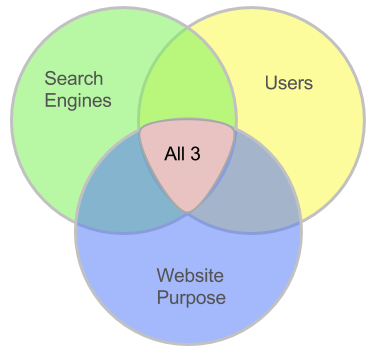
The strongest websites sit at the intersection of all three:
- User-focused experience
- Search-engine-friendly structure
- Clear business goals and conversions
Instead of optimizing for just one or two, plan your website with all three in mind from the start. This is where visual sitemaps and structured planning make the biggest difference.
Balanced websites aren’t accidental. They’re planned.
Happy website planning.

Comments
3 Comments
Estou gostando muito dos posts que estou lendo.
O conteúdo apresentado é muito direto e de fácil entendimento.
Muito obrigada!
Nothing like starting off my day reading and learning about something cool. Your blog post accentuated my breakfast perfectly! Thank you 🙂
Thanks Flavia! Great to hear the content is coming across as simple and direct =)
Leave a Comment