
The Hidden Cost of Bad Website Planning for Agencies
Agencies that rely on fragmented methods like Excel spreadsheets, static PDFs, or repurposed diagramming tools during the Information Architecture (IA) phase often find themselves facing a predictable set of challenges: excessive time loss, unexpected scope creep, and an endless cycle of revision.
This article explores the specific operational bottlenecks caused by poor planning and introduces WriteMaps, an agency website planning software designed to replace fragmented workflows with a single, collaborative artifact.
1. The Primary Cost: Administrative Time Loss and Internal Friction
The first hidden cost is time. In an agency environment, billable hours are the primary resource. When that resource is spent on manual, administrative, or non-strategic tasks, it represents a real financial loss.
Traditional website planning often involves several manual steps:
- Drawing and resizing boxes in a design tool just to show basic hierarchy.
- Chasing clients for content updates via long email threads and scattered documents.
- Manually compiling SEO metadata for developers at the end of the design phase.
- Cross-referencing spreadsheets with design mockups to ensure all pages are accounted for.
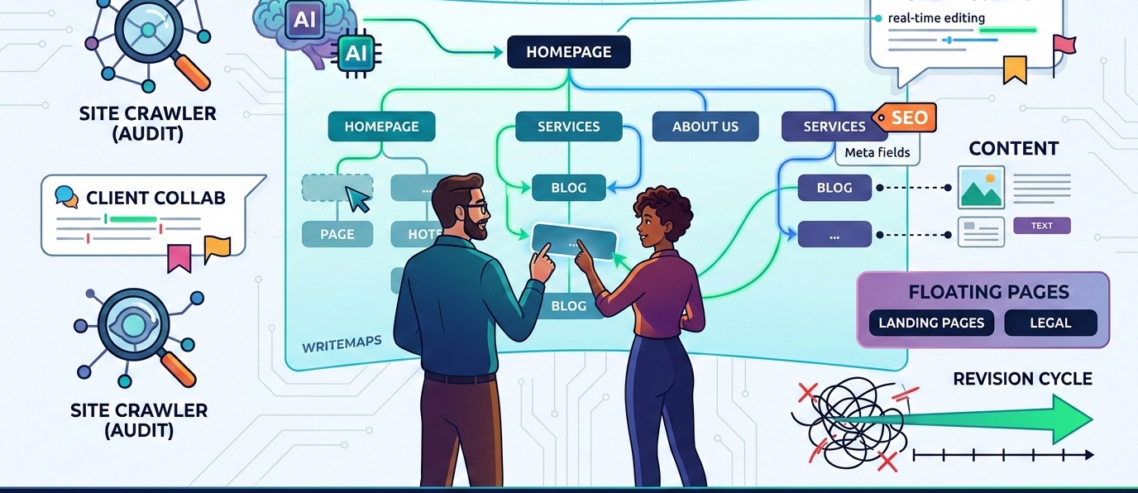
By shifting to dedicated website planning for agencies, teams can recover these lost hours. WriteMaps directly addresses this with its core feature, the Visual Sitemap Builder (Drag & Drop). Instead of fighting with design tools, users can jump from high-level ideas to a complete, visual structure in minutes, automatically handling the visual layout of lines and boxes. This shifts the focus immediately from “drawing the sitemap” to “optimizing the information architecture.”
2. The Scope Creep Problem: Why Agencies Need ‘Architectural Sign-off’
Scope creep is perhaps the most notorious project profitability killer. It often occurs when the initial vision for the website is vague or not mutually agreed upon in writing. In a redesign project, for example, it can be extremely difficult to get a complete picture of what is currently on a client’s site, let alone what should be migrated.
A structured approach to information architecture for agencies is essential to combat this. Tools like WriteMaps’ Site Crawler (Audit Mode) enable agencies to instantly generate a visual, “as-is” map of a client’s legacy site. This creates a baseline for discussion and helps identify redundant content that should be pruned. This is vital for presenting clear, accurate UX deliverables for clients before the new design begins.
Once the proposed sitemap is created, securing real-time collaboration & guest editing is the next step. Clients can use unique URLs to enter the project, leave notes, and provide feedback on the structure in real-time. This active collaboration leads to a formal, documented architectural sign-off, effectively locking the project scope before development starts and mitigating the risk of scope creep.
3. Content Delay: The Ultimate Project Bottleneck
Perhaps no factor causes more project delays than waiting on a client to provide website content. Often, this delay is not from a lack of will, but rather a lack of clarity. When clients are asked to “write content for the homepage” with no further structure, they become overwhelmed. This delay, however, directly impacts the agency’s ability to move to the next billable phase.
Agencies can proactively address this with a specialized sitemap tool for web designers that merges content gathering with structural planning. WriteMaps includes a Live Content Gathering Tool, which allows copywriters or clients to click directly onto any page of the sitemap and add text, attach files, or insert images. This ensures that the content is collected in context, aligned with the information architecture from day one, and drastically reduces the usual bottleneck.
The Solution: Replace 10 Meetings with 1 Artifact
To eliminate these hidden costs, agencies must transition from inefficient, meeting-intensive planning cycles to a process centered on a single, dynamic artifact. A tool that provides scalable IA for agencies is not just a diagramming application; it is a collaborative platform for delivery, audits, pitches, and sign-offs.
A Holistic Platform: Beyond Basic Mapping
WriteMaps is designed with this holistic vision, offering a robust set of features tailored specifically to agency workflows:
- Professional PDF Exports: When preparing client-ready sitemaps for a final presentation, a formal pitch, or as an attachment for a contract, agencies require a polished output. These high-quality exports provide a clear “blueprint” that serves as the official project documentation.
- SEO Management Fields: Efficient website planning requires integrating SEO from the beginning. Every page in a WriteMaps sitemap includes dedicated fields for Page Titles and Meta Descriptions. This lets agencies plan their keyword strategy early, ensuring all necessary SEO data is finalized well before the developer writes the first line of code.
- Color Coding & Tagging: The visual nature of a sitemap can also serve as a project management dashboard. Agencies use custom colors and tags to represent a page’s status (e.g., Green for *Approved*, Yellow for *Draft*, Red for *Needs Content*), providing a clear, at-a-glance overview of project progress for the entire team.
- XML & CSV Exports for Developers: The hand-off from design to development is often another source of error. To bridge this gap, WriteMaps allows agencies to export the complete sitemap as an XML file (for direct CMS import) or as a structured CSV spreadsheet. This gives developers a precise list of URL slugs and page titles, eliminating manual entry errors.
- Interactive “Sections”: Not every page of a website belongs in the main navigation. Agencies need to plan “floating” elements like specific landing pages, A/B test variations, or footer links. WriteMaps’ “Sections” feature allows agencies to group and organize these secondary page structures separately while keeping them all integrated within the single, unified project plan.
- AI Sitemap Generator: For the earliest stages of a project, the discovery phase, agencies use this AI tool for rapid brainstorming. This is perfect for generating potential navigation structures for new industries or conducting a fast audit of competitor site structures during the critical website planning for pitches phase.
Conclusion: The Path to Scale
The time spent grappling with outdated website planning methods isn’t just an inconvenience; it is a measurable drain on resources and a direct threat to an agency’s ability to scale. Effective client onboarding for web design depends on speed, clarity, and precision.
By centralizing Information Architecture, content gathering, SEO planning, and client feedback into one visual platform, agencies can recover lost billable hours, dramatically reduce revision cycles, and ensure that every project moves from the initial discovery call to architectural sign-off and, ultimately, to launch, with maximum efficiency and clarity. The solution isn’t another meeting; it is a single, authoritative artifact that unites the team and the client around a clear, actionable plan.

Comments
Leave a Comment